The Date: An Active Ingredient with a Rich History and Unexpected Benefits
As date harvesting season reaches its peak, we wanted to share with you everything there is to know about the universe and the almost magical symbolism of the date fruit — one of our star active ingredients. It is no coincidence that the date, a symbol of life and prosperity, has been revered for thousands of years across different cultures and religions.
In this article, we invite you to explore the world of the date and discover its lesser-known facets. More than ever, you will be convinced of its cosmetic virtues and its ability to smooth wrinkles, energize and illuminate the skin — much like the Saharan desert itself.
1. The Date and the Date Palm: Treasures for Body and Skin
The date palm — Phoenix dactylifera — has been cultivated for thousands of years in the arid regions of North Africa and the Middle East. It is an emblematic plant of these areas. Surprisingly, the date palm is not considered a “tree” in botanical terms. It does not produce wood and has no branches.
Its "trunk", called a stipe, is in fact a "false trunk" made up of overlapping leaf sheaths — the part of leaves that embrace the stem. Unlike a tree trunk, the date palm’s stipe has no growth rings. This is why the date palm does not grow thicker, but rather grows taller. There is such a wide variety of dates — each with its own color, texture and taste — that one can never tire of this astonishing, fleshy and highly nutritious fruit.
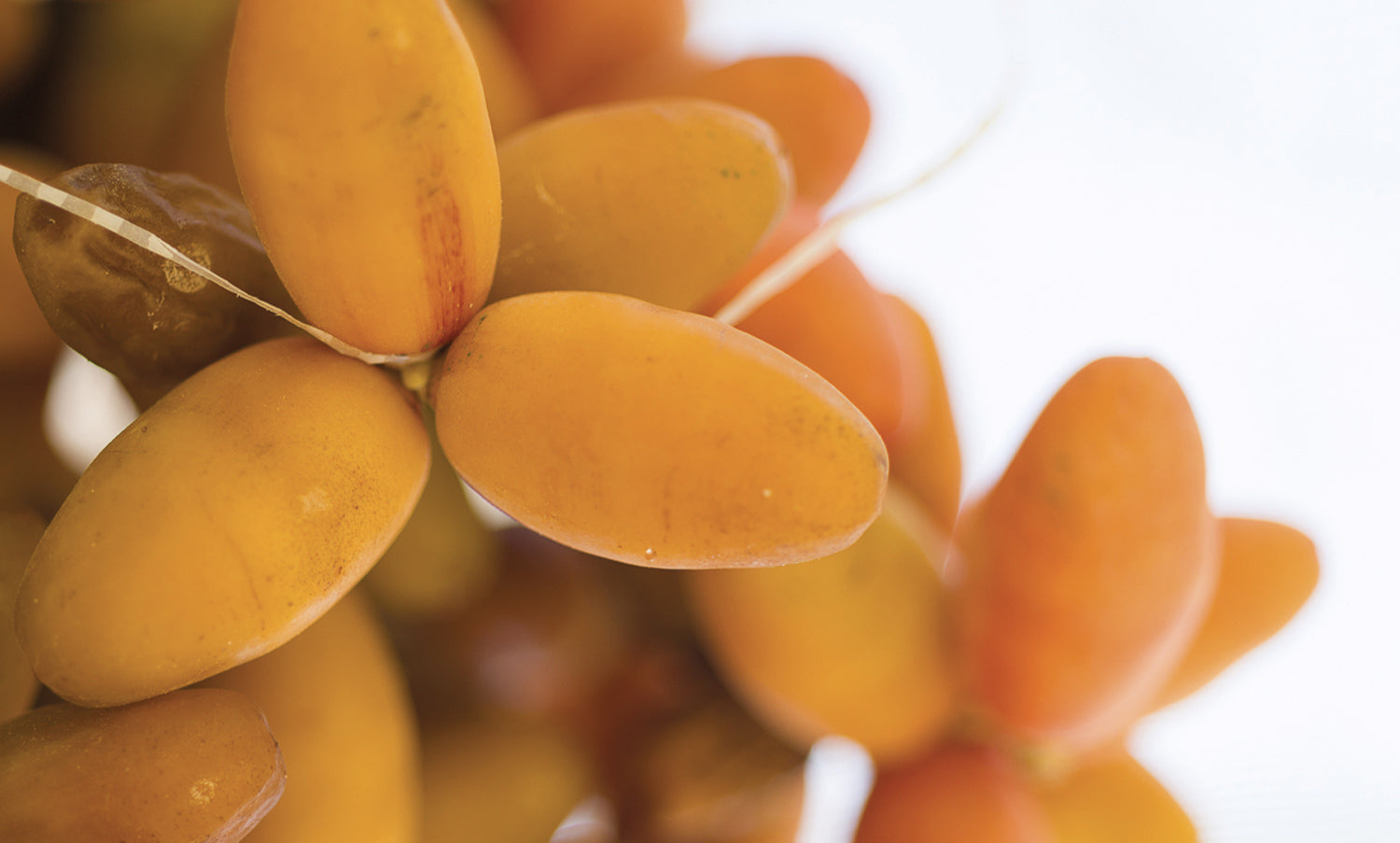
Why the word date? Quite simply because Aristotle thought the fruit resembled fingers (daktulos in Greek). Incidentally, Deglet Nour, the most prized of the 300 date varieties, means "finger of light" in Arabic. This variety comes mainly from Tunisia and Algeria.
This helps us understand the Latin origin of the name Phoenix dactylifera. The Greeks named the date palm "Phoenix" because of its extraordinary ability to survive after being partially burned — like the mythical phoenix rising from its ashes. Phoenix dactylifera therefore literally means: "the bird that rises from its ashes and bears fingers". This name alone already illustrates the revitalizing, regenerating and repairing power of the date — a power later widely confirmed by scientific research. This is one of the reasons why we fell in love with it and made it a cornerstone of our cosmetic formulations.
2. The Symbolism of the Date
From its earliest origins, the date has symbolized life, vitality and strength. Its exceptional nutritional qualities have made it a staple food, particularly for people living in the harshest desert environments.
2.1. A Fruit Associated with Celebration
The date is associated with celebration in many cultures and religions. Its presence on Christmas tables symbolizes the gifts brought by the Magi from the East. In Provence, a beautiful region in the South of France, the date is also part of the traditional 13 desserts, alongside nougat and dried fruits.
2.2. A Symbol of Conjugal Love
The date palm is a dioecious plant — meaning male and female trees are separate. For fruiting to occur, human intervention is required: female palms are hand-pollinated by shaking male inflorescences over female ones. This unique reproduction process has made the date a symbol of conjugal love in Arab cultures.
2.3. An Ideal Fruit During Pregnancy
A 2011 study published in the Journal of Obstetrics and Gynecology showed that dates contain oxytocin, often called the "love" or "bonding" hormone. Oxytocin stimulates uterine contractions and supports breastfeeding. Its Greek etymology literally means "rapid childbirth". The study concluded that consuming fresh dates during the four weeks before delivery reduced the need for induced labor and promoted natural childbirth.
3. The Cosmetic and Nutritional Benefits of the Date
The date was one of the first exotic fruits to reach Europe, thanks to proximity with North Africa and the Middle East. Consumed dried, it was featured in sweet-and-sour medieval recipes and, like honey, served as a sweetener long before cane sugar.
There are nearly 300 date varieties worldwide, but only a fraction are commercialized. The most well-known are Medjool dates from the Middle East — large, tender and caramel-like — and Deglet Nour, smaller, aromatic and exceptionally rich in nutrients. We use cold-pressed juice extracted from the pulp of organic, Demeter-certified Deglet Nour dates in our skincare. Dates can be consumed whole (fresh or dried) or transformed into valuable derivatives, detailed below.
3.1. Date Pulp Juice
Date pulp is rich in polyphenols and carotenoids, offering dual antioxidant action — free-radical scavenging and inhibition of lipid peroxidation — which slows cellular aging. It also contains trace elements such as copper, zinc and selenium with repairing, regenerating, anti-inflammatory and antioxidant effects.
Its amino acids and essential fatty acids provide strong hydrating power. Its vitamin B3 content contributes to skin brightening, while its high polysaccharide content gives it lifting properties and energizes cellular metabolism, delivering an instant glow.
Enjoy this 360° active ingredient in our "Perle Sacrée" rich cream, "Ange Sensationnel" intense cream, "Sève Divine" radiance mask, "Fraîcheur de l’Aube" invigorating eye contour, "Pépite de la Palmeraie" gentle exfoliator and "Fine Fleur" body cream.
3.2. Date Pit Powder
This base ingredient of traditional "desert coffee" has been used for centuries for its energizing and digestive properties. Rich in polyphenols, minerals and amino acids, it has antioxidant, firming and regenerating effects. Finely milled, it is used in our "Pépite de la Palmeraie" gentle exfoliator to revitalize, detoxify and instantly reveal renewed skin.
3.3. Virgin Date Pit Oil
Virgin date pit oil is an extremely rare and precious oil, requiring 2 to 3 tons of pits to produce just one liter. Extremely rich in polyphenols, sterols, vitamin E and carotenoids, it offers antioxidant, moisturizing, firming and toning benefits — and stands out for its broad-spectrum UV protection (UVA, UVB and UVC).
3.4. Date Sugar
Date sugar is an excellent natural alternative to refined sugar. It is made by drying and finely grinding dates. Its sweetness is subtler than cane sugar and it is most ideal for baking and pastry-making.
3.5. Date Vinegar and Spirits
Distilling fermented date juice produces a date spirit with up to 40% alcohol, traditionally consumed in the Middle East and Central Asia for both pleasure and digestive benefits. Date vinegar, used for thousands of years, supports immunity and helps reduce appetite thanks to acetic acid. With fruity notes similar to balsamic vinegar, it is delicious in salads.
As you can see, everything in the date is valuable — earning it true superfood status.
As the festive season approaches, try pairing dates with foie gras: replace fig or onion chutney with date purée (heated, blended pulp with a pinch of fleur de sel). A delight.
Dates are also perfect for energy balls. Here is our favorite recipe: blend 10 soft dates, 4 tbsp oats, 2 tbsp peanut butter and 1 tbsp agave syrup. Form balls, roll in cocoa or coconut, chill — and enjoy.
Final tip: to lower the glycemic impact of dates, consume them with proteins, fats or fiber (nuts, cheese, etc.).