How Does Our Skin Hydrate Itself?
Winter’s icy cold has set in, with its damaging consequences on skin hydration. Other factors such as wind, fatigue, or sun exposure in the mountains can further aggravate dehydration. This leads to a loss of suppleness, firmness, luminosity and tone. The skin becomes rough, dull, wilted, more wrinkled — and sometimes even inflamed. And your skincare products may no longer deliver the expected results.
Hydration therefore becomes, more than ever, an essential daily step at any age. Yet the epidermis’ hydration mechanisms are not simple: they work by controlling water loss, retaining water, and regulating how permeable our cells are to water.
Let’s explore these hydration mechanisms to better understand why it is important to hydrate your skin day and night. Before we go deeper, it is important to clarify that, whatever your skin type (dry, combination or oily), hydration is always essential. That said, dry skin requires added lipids through rich, nourishing hydrating textures, while combination to oily skin will generally benefit from lighter hydrating textures featuring emollient or sebum-regulating actives.
1. Preserving Epidermal Lipids
These lipids act like an oily mortar that cements our “bricks” — our skin cells — together. They create an almost watertight wall (while still allowing many molecules to pass through) and prevent the permanent, natural evaporation of water coming from the dermis. This process is known as Trans-Epidermal Water Loss (TEWL).
Water loss will be more or less intense depending on the quantity and quality of epidermal lipids, as well as the thickness and integrity of the outermost layer of the epidermis.
These lipids come from cells that, as they migrate from deep basal layers toward the stratum corneum, release lipids (cholesterol, ceramides, free fatty acids, etc.) into the extracellular space. With the help of enzymes, they play this “cement” structural role, ensuring cell cohesion and trapping water within the skin.
Both these membrane lipids and those of the hydrolipidic film regulate water flow and support skin hydration. The more hydrated the stratum corneum is, the more permeable it becomes — and therefore the better able it is to absorb the active ingredients in skincare.
Plant oils are the most commonly used lipid compounds in cosmetics, although butters, waxes, fatty acids and fatty esters are also often used. The most interesting are those rich in omega-3 and omega-6, such as virgin prickly pear seed oil and virgin apricot kernel oil, present in our replenishing serum and face cream for the first, and in our radiance mask for the latter.
2. Strengthening Natural Moisturizing Factors (NMF)
This is a hydration mechanism that takes place inside the cell. Cells in the stratum corneum contain keratin, a fibrous protein whose filaments form a dense network. The water contained in these cells binds to these filaments thanks to a set of components called Natural Moisturizing Factors (NMF). NMF are a blend of hygroscopic substances that help bind water molecules in the stratum corneum. They give the skin suppleness and protect it from external aggressors.
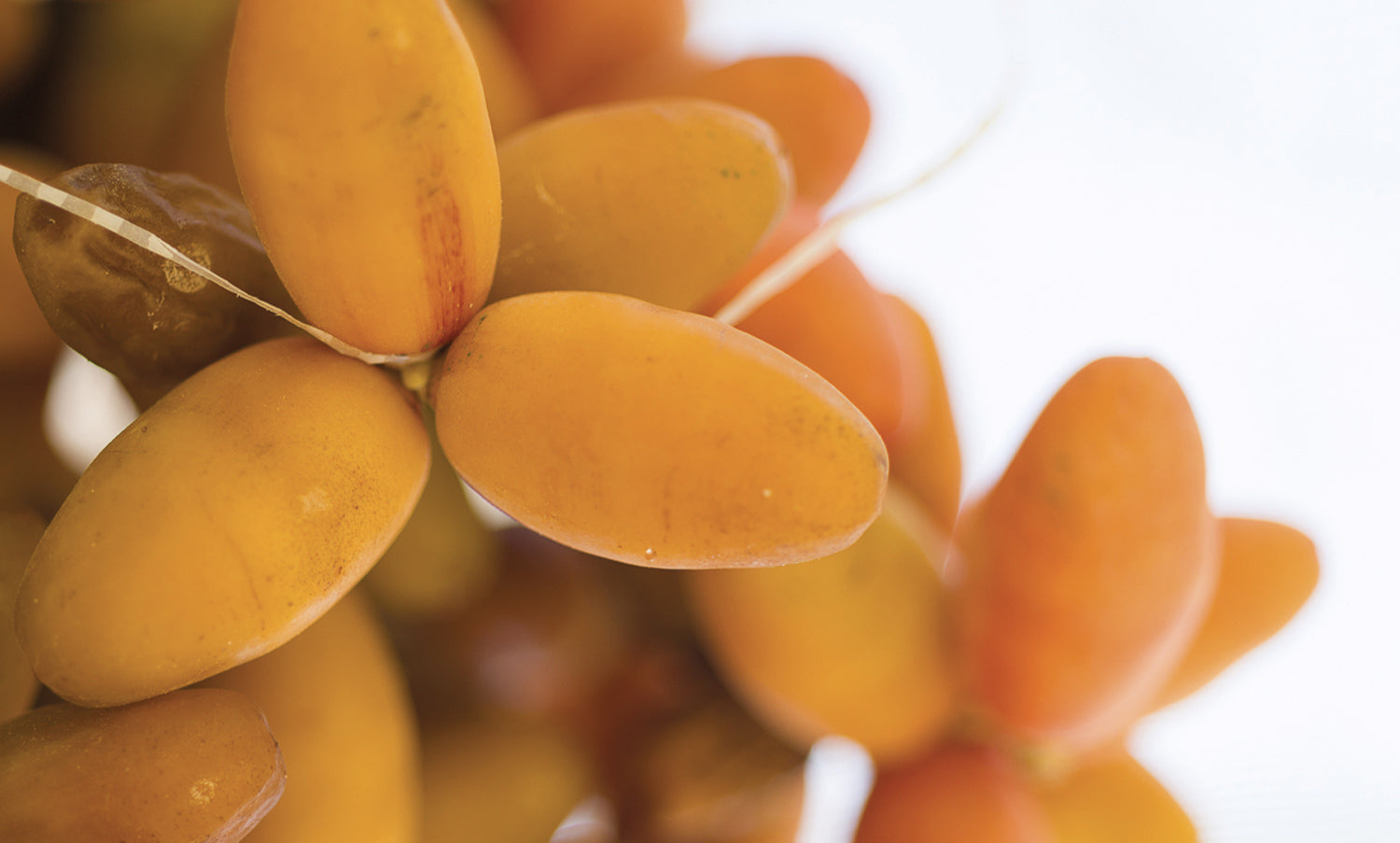
Amino acids are part of these Natural Moisturizing Factors. They are also highly present in our star active ingredient — the date — which helps explain its hydrating power. You will find date in our two face creams, our body cream, our glow mask, our gentle exfoliant and our eye contour.
Humectant actives also have the ability to bind water molecules. Glycerin is the most commonly used humectant in cosmetics for long-lasting hydration.
3. Acting on Aquaporins
Aquaporins are proteins discovered in 1990 by biologist and Nobel Prize winner Peter Agre. These proteins form channels that allow water — and not other substances — to pass through the superficial layer of cells. Much like an hourglass lets sand grains (water molecules) pass through its narrowest part.
To date, several hundred aquaporins have been discovered. Each type has a specific tissue location in the body (epidermis, stomach, intestine, kidney, brain, etc.) and is named AQP followed by a number. Their function is controlled by hormones such as vasopressin and can be inhibited by certain toxins.
Aquaporins play a major role in controlling hydration flows, allowing organ cells to absorb, retain or release water — while preventing the entry of undesirable molecules or the loss of essential ones.
Acacia seed extract, present in our glow and hydration-boosting serum "Voile Lacté", is a concentrate of biomimetic acacia-derived peptides (alert signals). Its action helps restore aquaporins and therefore supports water distribution within our cells.
4. Stimulating the Synthesis of Glycosaminoglycans (GAG)
65% to 70% of the human body is composed of water. Skin contains a similar overall proportion, but with significant differences across layers. The hypodermis contains around 20% water, the dermis 80%, the epidermis 60%, and the stratum corneum only 10%. The dermis is therefore the skin’s most important water reservoir.
However, this water is “non-mobile” because, unlike “free water,” it is bound within the dermis by large molecules — glycosaminoglycans (GAGs) — and cannot evaporate.
Hyaluronic acid is one of these molecules and can bind up to 1,000 times its volume in water. It occupies the space between cells abundantly. Unfortunately, its natural production decreases steadily with age: by age 50, the body contains only about half the amount present in childhood.
Hyaluronic acid exists in three molecular weights. The lower the molecular weight, the deeper it can penetrate. Our intense cream "Ange Sensationnel" features low and medium molecular weight hyaluronic acid.
You now have a clear view of the skin’s hydration mechanisms. Finally, keep in mind that facial hydration can be optimized by using a very gentle, non-stripping cleanser before applying skincare. Applying a lotion like Pure Merveille can also help hydrate and soothe dehydrated skin that is often irritated.